
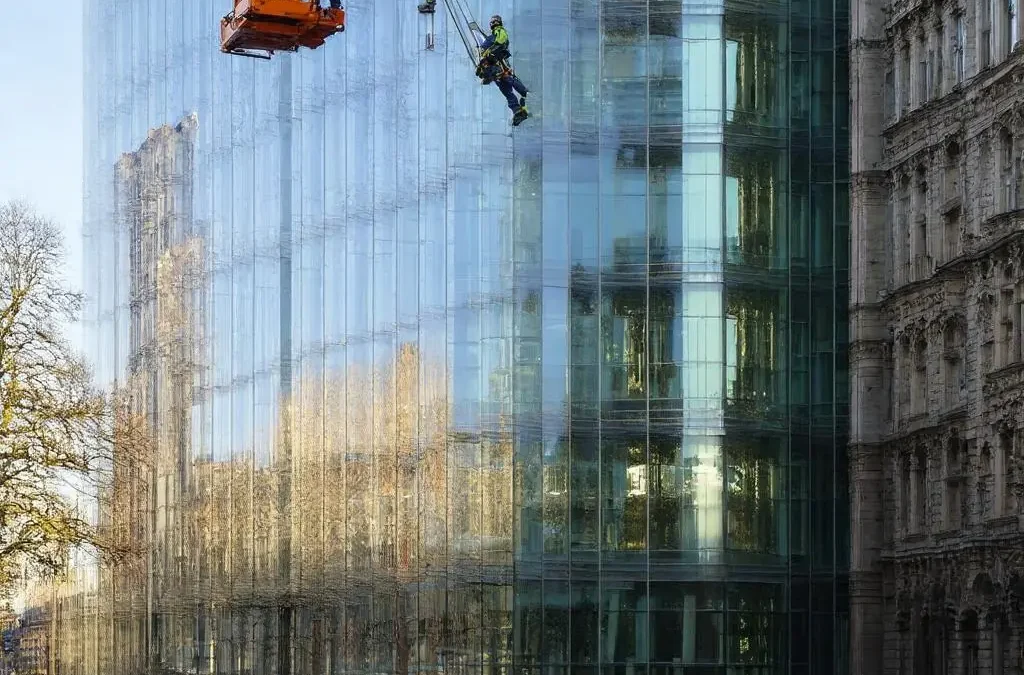
Not all buildings—and budgets—are the same, and choosing the right window cleaning access method is about aligning risk, cost, and operational impact with your site’s realities. For London facilities and property managers, the decision should be driven by the following factors:
- Height and geometry: overall building height, roof set-backs, atria, overhangs, and recessed glazing.
- Façade materials and condition: glazed curtain wall, stone, cladding, heritage façades, coatings, and any delicate or porous finishes.
- Public footfall and tenancy profile: retail trading hours, pedestrian density, safeguarding around entrances, and peak office occupancy patterns.
- Street access and logistics: kerbside space, red routes, loading bays, parking restrictions, and requirements for traffic management.
- Uptime requirements: tolerance for disruption, acceptable working windows (out-of-hours, early mornings), and noise limitations.
- Existing access assets: façade maintenance units (cradles/BMUs), tested abseil anchors, roof access routes, and plant constraints.
- Compliance expectations: demonstrable adherence to the Work at Height Regulations 2005, environmental controls, and auditable quality.
- Budget and frequency: one-off deep cleans versus scheduled year‑round programmes, and the total cost of ownership (including permits or equipment hire).
With this framework, the “right” method is the one that minimises risk at source, maintains compliance and quality, and delivers the best value for your building’s use case—not simply the cheapest line item on a quote.
Choosing between access methods: what works when
Each access technique has a distinct profile of reach, risk, logistics, and cost. The overview below supports fast, defensible decisions.
-
Water-fed pole (WFP) systems
- Best for: Low to mid-rise elevations (typically up to 4–6 storeys depending on surroundings), large panes, regular maintenance cleans where pure water finish is acceptable.
- Strengths: Excellent value; minimal disruption; quick set-up; no need for road closures; reduces detergent use and run-off risk when paired with pure water.
- Considerations: Requires suitable set-back and ground space; wind exposure can affect control at height; not ideal for heavy soiling or ingrained deposits; slip hazard management needed around entrances.
- Compliance notes: Still subject to Work at Height principles (though risk is lower from ground). Water purity (TDS) control and site-specific exclusion zones should be documented.
-
Ladders
- Best for: Very low-level, short-duration tasks where other access is impractical.
- Strengths: Rapid deployment; minimal kit.
- Considerations: Restricted by regulation and best practice; should be used only when risk is low and duration is brief; tie-off and footing controls required; often superseded by WFP for efficiency and safety.
- Compliance notes: Follow the hierarchy of control—only select ladders where safer alternatives are not reasonably practicable. Training and documented method statements are essential.
-
Abseiling (rope access)
- Best for: High-rise and complex geometries without installed cradle systems; façades with limited street-level access; atria and internal voids where MEWPs cannot reach.
- Strengths: Highly adaptable; minimal ground footprint; cost-effective on tall structures; excellent for detail work and full-elevation coverage.
- Considerations: Weather-dependent (especially wind); requires certified anchors or temporary rigging solutions; plan for exclusion zones and public protection below.
- Compliance notes: Look for IRATA-certified technicians and procedures aligned with BS 7985. Anchor certification must be up to date; comprehensive rescue planning is mandatory.
-
Installed cradle systems (BMU/cradle access)
- Best for: Buildings designed for frequent façade maintenance; high and very high-rise with predictable routes and repeatable tasks.
- Strengths: Consistent coverage; efficient for regular programmes; low incremental cost once installed; preferred for very tall curtain walls.
- Considerations: Requires LOLER-compliant thorough examinations, maintenance, and competent operators; operational downtime if the system is out of service.
- Compliance notes: Evidence of LOLER inspections and operator training should be kept on file. Method statements must reflect manufacturer limits and emergency procedures.
-
Mobile elevating work platforms (MEWPs)
- Best for: Mid to high elevations where street access allows; façades above canopies; specific areas needing focused work; short-term projects without installed systems.
- Strengths: Rapid access to targeted zones; stable working platform; good for deep cleaning or remedials.
- Considerations: Requires suitable pavement/road access, ground bearing capacity checks, and often permits/traffic management; subject to wind limits; hire and traffic costs can add up.
- Compliance notes: IPAF-certified operators, pre-use checks, and LOLER regimes apply. Traffic management and pedestrian segregation plans are essential on London streets.
Selecting the optimal method often means combining techniques. A mixed-method programme might use WFP for upper bands, MEWPs for canopies and signage, and hand-detailing around entrances out of hours. The governing principle is the Work at Height hierarchy: avoid where you can, prevent falls where possible, and minimise the distance and consequences of any remaining risk—while optimising quality and cost.
Safety, compliance and quality you can evidence
Facilities managers must be able to demonstrate not just a safe outcome, but a controlled process. The following controls provide assurance to stakeholders, auditors, and insurers:
-
Management systems and accreditation
- ISO 9001 (Quality): Documented procedures, audit trails, KPIs, and continuous improvement.
- ISO 14001 (Environmental): Reduced chemical use, controlled water discharge, waste management, and spill response.
- ISO 45001 (Occupational Health & Safety): Risk assessments, training, consultation, incident reporting, and wellbeing.
- SafeContractor approval: Independent verification of health, safety, and ethical standards.
- Role-specific competence: IRATA (rope access), IPAF (MEWPs), Ladder Association, first aid, and site inductions; DBS checks where relevant.
-
Planning and permissions
- RAMS tailored to each elevation, including anchor certifications, LOLER/PUWER records, emergency and rescue plans, and public protection measures.
- Traffic and street works considerations: permits, suspensions, and red route planning; banksmen and barriers to manage pedestrian interfaces.
- Building-specific controls: façade access manuals for BMUs, rooftop work permits, confined space considerations for internal atria, and security protocols.
-
Environmental and quality controls in practice
- Use of pure water systems with monitored TDS for spot-free finishes; targeted use of approved detergents for heavy soiling, with run-off minimised, captured, or neutralised.
- Wind, weather, and temperature thresholds set by manufacturer limits and risk assessment (especially for MEWPs and rope access).
- Quality verification: photographic records, sample panes, sign-off by floor or zone, and agreed benchmarks for clarity, edges, frames, and sills.
- Transparent reporting: post-clean reports, asset condition notes (e.g., failed seals, damaged gaskets), and non-conformance logs to support proactive maintenance.
Working with a contractor whose systems align to ISO 9001/14001/45001 and who holds SafeContractor approval gives you a robust, auditable foundation for compliance—vital in London’s regulated and high-footfall environments.
Planning for London: year‑round, low‑disruption cleans
London-specific realities can materially change the best access choice and cleaning schedule. Address these early to minimise disruption and protect your corporate image.
-
Footfall and trading hours
- Retail: schedule cleans outside trading hours; demarcate entrances; deploy spotters to protect the public; use quieter methods near opening times; manage slip risks with containment and signage.
- Offices: early morning or evening cleans reduce lift waits and visitor clash; agree “no-go” meeting windows; coordinate with reception and security for passes.
-
Street access and logistics
- Pre-book loading bays or parking suspensions; avoid red-route restrictions; use compact MEWPs where practical; plan for banksmen and barriered exclusion zones; minimise dwell times on the highway.
- For constrained pavements, consider abseil or cradle access to avoid road occupation altogether.
-
Façade materials and finish expectations
- Glass and coated panels respond well to pure water; porous stone and heritage façades may need specialist techniques and sensitive detergents.
- Test patches allow validation of method and finish before full deployment, protecting both fabric and brand standards.
-
Weather and seasonality
- Wind governs rope access and MEWP operations; have contingency days in the programme.
- Winter: shorter daylight and lower temperatures require adapted shift plans; deploy de-icing and additional slip controls.
- Pollution and construction dust levels in central London often justify higher cleaning frequencies on lower bands and entrance glazing.
-
Programme design and KPIs
- Zone-by-zone plans reduce interference with tenants and visitors.
- Blend quarterly full-elevation cleans with higher-frequency touches at eye level and entrances.
- Track KPIs such as first-time pass rate, re-clean rate, near-miss reporting, and tenant satisfaction. Share audit summaries to evidence value and compliance.
An effective year‑round plan is not just about clean glass; it is about continuity of operations, safety assurance, and measurable enhancement of your building’s presentation.
Scoping a site survey and next steps
A thorough survey is the foundation of a safe, compliant, and cost-effective solution. To accelerate quoting and mobilise swiftly, prepare the following:
-
Building information
- Elevations, roof plans, and any façade access manuals (BMU/cradle).
- Details of existing abseil anchors with latest certification.
- Façade materials, coatings, and any past issues (leaks, failed seals, staining).
- Access constraints: security procedures, loading bays, red routes, road closures, or event schedules.
-
Operational requirements
- Preferred working hours and blackout periods (retail opening, office events).
- Public protection standards around entrances and thoroughfares.
- Desired frequency by elevation band and critical areas (receptions, signage, canopies).
-
Compliance documentation
- Contractor expectations for ISO 9001/14001/45001 alignment and SafeContractor approval.
- Evidence of competence (IRATA/IPAF/Ladder Association), RAMS, and emergency plans.
- Environmental controls: detergent approvals, run-off management, and waste arrangements.
What to expect from a competent contractor’s survey:
- A collaborative risk assessment and proposed method hierarchy (e.g., cradle first, abseil as contingency).
- Validation of anchor points and BMU readiness, or recommendations for temporary solutions.
- A method statement with logistical plan, pedestrian and traffic management, and communications approach for tenants.
- A transparent cost model that separates recurring service from one-off set-up, permits, or hire, enabling you to optimise budget.
Efficient Cleaning Services has two decades of experience across London and the South East delivering safe, high-quality window and façade cleaning for offices and retail estates. We combine water-fed pole systems, abseiling, ladders, cradle operations, and mobile platforms to suit buildings of any height, supported by ISO 9001/14001/45001-certified management systems and SafeContractor approval.
To discuss the most suitable access method for your site, arrange a site survey, or plan a year‑round programme, request a free quote via our website. Provide your building particulars and preferred time windows, and our team will propose a tailored, compliant, and cost-effective solution that minimises disruption and elevates your corporate image.
Recent Comments