
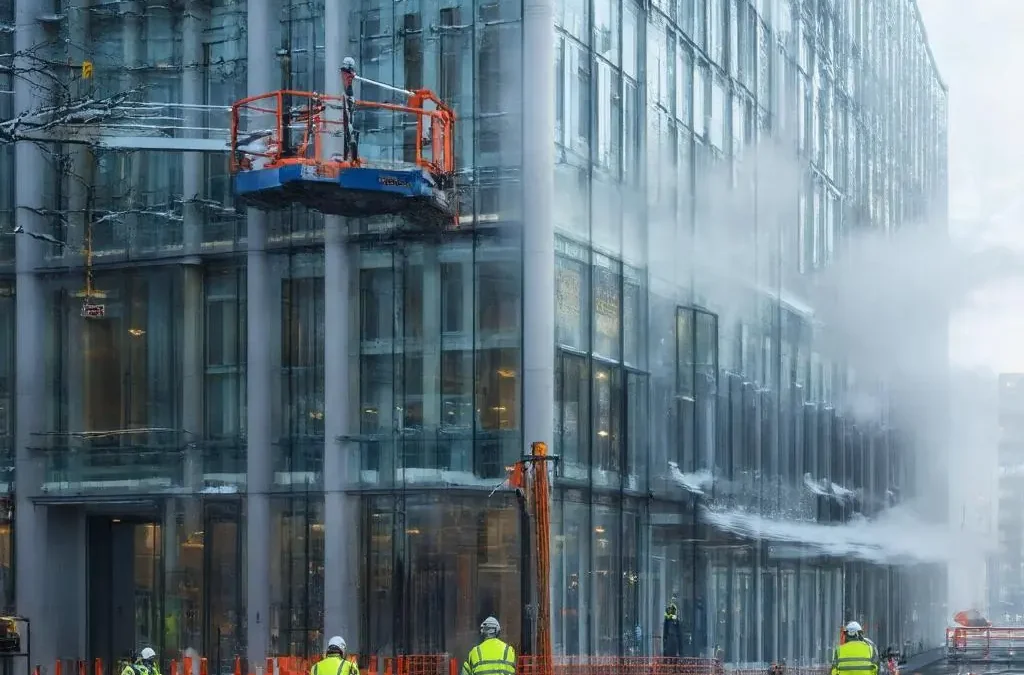
With cold snaps in the headlines, the most important winter discipline is a thorough risk assessment before any team leaves the yard. For exterior glass and façade cleaning, Efficient Cleaning Services builds dynamic, weather-led checks into every visit. That starts with reviewing Met Office forecasts and site-specific conditions (microclimates, shading, elevated walkways, exposed roofs) and continues with an on-arrival assessment covering ice, snow, high winds, freezing rain and reduced daylight.
Clear go/no-go criteria protect both operatives and the public. While exact limits are determined by manufacturers’ instructions and method statements, our winter matrix typically includes:
- Rope access and cradles: suspension systems are stopped if wind speeds or gusts exceed defined thresholds, if anchor points are iced, or if precipitation risks icing of ropes, sheaves or rescue equipment. Ice or snow load on roofs and parapets is a no-go until made safe.
- Mobile elevating work platforms (MEWPs): operation is paused if wind speeds exceed the machine’s rated limit, if ground conditions are unstable or frozen with inadequate bearing, or if visibility is compromised. Outrigger and spreader arrangements are verified for frozen substrates.
- Ladders and short-duration access: only where justified by risk assessment, on secure, de-iced footing, with stabilisation, exclusion zones and strict duration limits.
- Water-fed poles (WFP): heated purified water and insulated lines are used to mitigate freezing on the glass and in the system. If run-off could re-freeze on pedestrian routes faster than it can be controlled, we switch methods or reschedule.
Method switching is central to maintaining service continuity. For example:
- If winds are marginal for rope access, we may complete lower elevations by WFP from secure, de-iced ground, deferring high-rise work to a safer window.
- If ground-level conditions are the constraint, a building maintenance unit or cradle may be used where wind and equipment checks permit, with robust exclusion zones.
- If neither approach can be made safe, we pivot to interior glass, sheltered elevations or façade detail cleaning until the weather window opens. No clean is worth a fall.
Ground-level safety and water management
The majority of winter incidents occur at ground level. Robust controls protect building users and operatives alike:
- De-icing pedestrian routes. Before work begins, nominated access routes for operatives and public diversion paths are de-iced and inspected. Where appropriate, we use environmentally responsible de-icers (for example, calcium magnesium acetate) instead of rock salt near sensitive landscaping, metalwork and drainage points. Snow is cleared, not compacted.
- Water management to prevent pooling and re-freeze. Heated purified water reduces instant icing on glass. Flow rates are adjusted, and we use drip trays, absorbent mats and wet vacs to capture run-off. We direct any residual water safely to drains, confirming grates are clear and not iced over. Final passes remove excess water on sills, and a post-clean inspection confirms walking surfaces are left dry. Where the sun drops early, we schedule so that any residual moisture evaporates in daylight hours.
- Exclusion zones and clear signage. Conspicuous barriers, banksmen and “Cleaning in progress”/“Caution – slippery surface” signage keep the public outside drop zones and away from equipment. Entrances are managed to avoid cross-traffic with work areas; where necessary, temporary closures and diversions are agreed with the site team to maintain safe access.
- Housekeeping. Hoses are routed to avoid trip hazards and kept off icy patches. Tools are tethered. As areas are released, they are re-checked for re-freeze and re-treated as required.
These controls are documented in risk assessments and method statements (RAMS) and verified on the day via toolbox talks and dynamic risk assessments.
People, equipment and platforms: winter-ready
Cold weather is unforgiving on people and assets. We specify, inspect and care for equipment and PPE with winter conditions in mind:
- PPE for cold, dexterity and visibility. Thermal, cut-appropriate gloves with EN 511 cold resistance retain dexterity on poles and lines. Insulated, waterproof footwear with SRC-rated slip resistance and protective toecaps reduces slip and impact risk. Anti-fog eye protection rated for low temperatures, helmet liners, and layered high-visibility clothing maintain comfort and awareness without snag hazards.
- Rope access and fall protection. Ropes, lanyards and connectors are checked for stiffness, moisture ingress and ice formation. Equipment is kept dry and protected from freezing; iced hardware is taken out of service and thawed naturally before reinspection. Back-up systems and rescue plans are re-briefed in light of weather conditions. Edge and anchor points are cleared and verified before loading.
- Cradles and building maintenance units. Pre-use checks cover emergency descent, communication devices, wind-speed monitoring and anti-icing of guardrails, floors and controls. Particular attention is given to ice at rollers and suspension points.
- MEWPs and mobile platforms. Batteries are fully charged and kept warm where possible (cold significantly reduces capacity). Engines and hydraulics are checked for winter-grade fluids; diesel machines use appropriate winter fuel to prevent waxing. Guardrails, decks and steps are cleared of ice, tyres are correctly inflated and ground bearing is confirmed with spreader pads on frozen or soft ground. All checks are recorded, and only competent, authorised operators are deployed.
- Water-fed systems. Tanks are insulated, lines are lagged, and heaters are used to maintain flow in low temperatures. Lines are purged at the end of shifts to prevent overnight freezing. We do not add harmful antifreeze to purified water; instead we rely on heated systems, scheduling and water management to achieve a spot-free, safe result.
Daily inspections are non-negotiable. Winter accelerates wear and exposes hidden defects; any non-conformity results in equipment being quarantined until rectified.
Planning, communication and compliance with standards
Keeping services reliable in winter is as much about planning as it is about technique. Our approach includes:
- Flexible scheduling. We plan work around reliable forecasts, building in contingency windows and prioritising elevations most exposed to wind and weather early in the day. Multi-site routes are sequenced to take advantage of local microclimates across London and the South East, with rapid rescheduling when conditions change.
- Clear communication protocols. Before arrival, we agree the day’s plan, access routes and exclusion zones with site teams. On the day, a named supervisor provides updates on go/no-go decisions, method switches and any temporary closures. After completion, we share a concise report with photos, any defects noted, and re-clean or maintenance recommendations.
- Contingency and rescheduling policies. Where weather prevents safe delivery, we offer pre-agreed contingencies: switching to interior glass, sheltered façades or alternative blocks on a campus; rapid rebooking at the next weather window; or aggregating deferred tasks to reduce access costs. Our aim is continuity without compromising safety.
- Documentation and competence. Winter or not, compliance is mandatory. We operate under the Work at Height Regulations 2005, with tasks planned and supervised by competent persons. Lifting operations and equipment comply with LOLER 1998 (including thorough examinations at prescribed intervals) and PUWER 1998. Rope access follows recognised best practice (for example, BS 7985 and industry codes of practice), and MEWPs are used strictly in line with manufacturers’ instructions. All activities are underpinned by certified management systems: ISO 9001 for quality, ISO 14001 for environmental management and ISO 45001 for occupational health and safety. Our SafeContractor approval and affiliation with professional bodies such as BICSc and the Federation of Window Cleaners reinforce our commitment to compliance and competence.
- Environmental responsibility. Winter products and practices are selected with care. We use purified water as the default on glass to avoid detergents and residues. Where detergents are necessary (e.g., façade restoration), we choose biodegradable, non-taint, non-toxic solutions and control run-off to prevent entry into watercourses. De-icers are chosen to minimise corrosion and environmental harm, and any grit or residue is removed at the end of the task. Waste is handled and disposed of in line with site requirements and our ISO 14001 procedures.
Behind the scenes, our leadership team continually reviews incident data, near-misses and innovations from across multiple sectors to refine winter procedures, supported by investment in recruitment, training and communication so that every operative understands both the plan and the reason behind it.
The business case for winter cleaning and portfolio-wide consistency
There is strong commercial logic for maintaining exterior glass and façades through the winter months:
- Reduced damage from salt, grit and pollution. Winter gritting and traffic pollution build up quickly on glass, frames and sills. Left in place, these deposits can etch glazing, stain stone and aluminium, and accelerate corrosion of fittings and seals. Regular winter cleans protect assets and avoid higher remediation costs.
- Better daylight in low sun. Short days and low sun angles amplify the impact of dirty glass on internal light levels. Clean glazing improves daylighting, reduces reliance on artificial lighting at the margins and enhances occupant wellbeing.
- Consistent professional image. Retail frontages, office receptions and corporate façades carry brand value year-round. Clean, streak-free glass projects the right impression to customers, colleagues and visitors, even in adverse weather.
For multi-site portfolios, pairing façade cleaning with interior glass maintenance delivers consistent results. Synchronising cycles—for example, exterior cleans followed promptly by interior glass and lobby glazing—eliminates shadowing, ensures a uniform finish and allows portfolio-wide reporting on standards achieved. Our teams operate year-round across London and the South East, with the specialist access capability to service buildings of any height via water-fed pole systems, abseiling, cradles and mobile platforms. That flexibility, combined with rigorous safety and certified quality control, keeps programmes on track cost-effectively, even in cold weather.
If you would like to review your winter cleaning plan, schedule a site assessment or request a free, no-obligation quote, our London-based team is ready to help. We will tailor a compliant, sustainable solution to your sites, keep people safe and your buildings looking their best until spring.
Recent Comments