
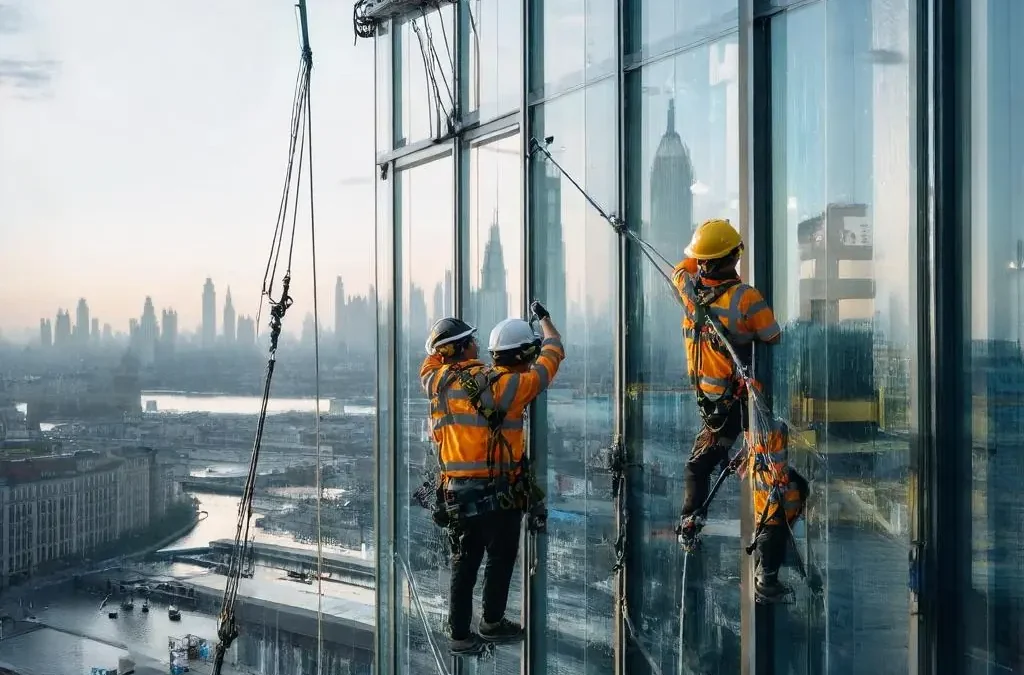
Across the UK, facilities services are consolidating. Larger, multi-service providers are acquiring regional specialists to build operational density in major metropolitan areas—especially London and the South East—shorten travel times, and roll out technology-enabled processes at scale. For commercial property managers and estates teams, this shift can offer tangible benefits: a single point of accountability, broader coverage (from day porter and floor care through to specialist window and façade cleaning), and potential efficiencies in scheduling and mobilisation.
However, these gains only translate into day-to-day value when three non‑negotiables are preserved: uncompromising safety, consistent quality, and genuine local expertise. High‑rise window and façade cleaning is a specialist discipline. It relies on trained people, certified systems, and the right access method for each elevation. The best outcomes come from providers who combine scale with a disciplined safety culture and deep, site‑specific knowledge of London’s built environment—from access constraints and permits to weather windows, traffic patterns, and public footfall risks.
Consolidation is not an automatic upgrade. It is a change in delivery model that requires careful buyer scrutiny to ensure you receive improved responsiveness and cost‑effectiveness without sacrificing corporate image, compliance, or occupant safety.
Opportunities and risks: what improves, what must not change
What can improve:
- Operational density: Larger route networks and crew availability can reduce dead mileage and improve response times, particularly across central London, Canary Wharf, the City, and key South East corridors.
- Integrated services: Window and façade cleaning aligned with day porter, periodic floor care, and external maintenance can streamline communication, simplify invoicing, and support consistent presentation standards.
- Technology uplift: Digital RAMS (Risk Assessments and Method Statements), real‑time scheduling, GPS‑verified attendance, photo‑led quality audits, and client dashboards provide transparency, faster issue resolution, and clearer KPI tracking.
What must not change:
- Safety first, always: High‑rise work demands robust systems—method selection, equipment inspection, rescue plans, and strict weather thresholds. These are not negotiable in the pursuit of efficiency.
- Local expertise: London sites require familiarity with restrictions (e.g., loading bays, parking suspensions, road closures, ULEZ compliance, and congestion charging), as well as stakeholder sensitivities in mixed‑use and high‑footfall areas.
- Supervision and training: Consolidation should never dilute supervisor presence, toolbox talks, refresher training, or on‑site competency checks.
- Quality control: Certified quality management and systematic audits must survive any integration—your brand reputation depends on clean glass, undisturbed occupants, and spotless atria and façades.
A practical buyer’s checklist for consolidated providers
Use this checklist to validate that a larger, consolidated provider can deliver specialist window and façade cleaning safely, consistently, and cost‑effectively.
- Certifications: Verify ISO 9001 (quality), ISO 14001 (environmental management), and ISO 45001 (occupational health and safety), or internationally recognised equivalents.
- Third‑party accreditations: Look for SafeContractor (or equivalent) approvals and relevant trade affiliations such as BICSc and the Federation of Window Cleaners (FWC).
- RAMS quality: Demand site‑specific RAMS, including access and rescue plans, equipment inspection regimes, and wind/ice thresholds for rope access, cradle work, and water‑fed pole systems.
- Incident performance: Request recent incident metrics (e.g., RIDDOR reports, near‑miss rates) and evidence of corrective actions.
2) High‑rise access capabilities
- Methods: Confirm competence in water‑fed pole systems, rope access (abseiling), ladder and cradle access, and mobile elevating work platforms (MEWPs).
- Decision logic: Ask for the access method matrix for each elevation—why it was selected, how it manages public interface risks, and how rescue would be performed.
- Equipment assurance: Check inspection records, LOLER certificates for lifting equipment, and technician competencies (e.g., IRATA for rope access).
3) Training, supervision, and workforce continuity
- Competency: Review induction, refresher training, and specialist modules (e.g., chemicals handling, glass types, façade materials).
- Supervision: Confirm supervisor‑to‑team ratios, planned site visits, and quality audit frequency.
- Continuity through change: During transitions or acquisitions, ensure continuity of on‑site teams where possible, supported by a clear mobilisation plan, communications framework, and change controls. Where TUPE applies, seek clarity on consultation, culture integration, and retention.
4) Environmental practices
- Chemicals and water: Prefer minimal‑impact, approved detergents; closed‑loop or filtered pure‑water systems; and responsible run‑off management.
- Waste and emissions: Ask about waste disposal processes and fleet standards (Euro VI, ULEZ‑compliant vehicles) to minimise environmental impact and avoid access penalties.
- Targets and reporting: Look for measurable environmental objectives tied to ISO 14001 and client reporting.
5) Scheduling and adverse weather procedures
- Year‑round service: Confirm a 12‑month schedule with clear seasonal adjustments and contingency slots.
- Weather protocols: Insist on defined wind speed thresholds for rope and cradle work, ice controls for early starts, lightning guidance, and re‑booking rules that protect safety without inflating costs.
6) SLAs, KPIs, and communication
- SLAs and KPIs: Lock in response times, completion windows, quality scores, and rectification targets.
- Reporting: Require photo‑verified completion, exception logs, and a client portal or scheduled report pack.
- Communication lines: Establish named contacts, an escalation matrix, and agreed meeting cadence (e.g., monthly reviews, quarterly continuous improvement sessions).
7) Cost transparency and risk allocation
- Scope clarity: Ensure the proposal sets out frequencies, elevations, access methods, traffic management, out‑of‑hours needs, and public protection (barriers, lookouts).
- Risk ownership: Confirm who supplies, inspects, and insures MEWPs, cradles, or lifting gear; check permit and parking responsibilities.
- Variations: Define a change‑control process so ad hoc cleans, event resets, or façade works are priced predictably.
Benchmarking cost‑effectiveness in London and the South East—and when to request a survey and quote
Achieving best value in London and the South East is seldom about the lowest headline rate. It is about total cost of safe delivery, sustained over the contract term, without reputational or compliance risk. Use the following benchmarks to compare proposals fairly:
- Operational density and travel time: Providers with established London/South East teams should evidence shorter travel legs and reduced non‑productive time. Translate this into unit costs and availability during peak periods.
- Access method optimisation: Assess whether the chosen methods minimise disruption while meeting safety constraints. For example, using water‑fed poles for lower elevations and rope access for set‑back façades can reduce MEWP hire and traffic management costs—provided rescue plans and wind limits are sound.
- Supervision and rework rates: Strong supervision correlates with fewer defects and call‑backs. Ask for rework statistics and the embedded cost of quality control (audits per visit).
- Quality assurance maturity: ISO 9001‑driven processes should show consistent right‑first‑time performance; seek evidence from audit summaries and trend charts rather than generic statements.
- Environmental efficiency: ULEZ‑compliant fleets, modern route planning, and pure‑water systems can reduce both emissions and access constraints, lowering indirect costs such as parking penalties or rescheduling.
- Public interface management: In high‑footfall or retail settings, check how the provider protects the public (barriers, signage, spotters) and schedules around trading hours to avoid reputational risk.
- Data and transparency: Digital attendance records, photo evidence, and KPI dashboards reduce time spent on validation and dispute resolution—value that does not always appear in unit rates.
- Corporate image outcomes: Include qualitative criteria—streak‑free glazing, clean atria, spotless frames and sills, and minimal disruption to occupants—in your evaluation matrix. Cheap work that compromises presentation is a hidden cost.
When to request a site survey:
- Multi‑storey or high‑rise assets, complex façades, limited ground access, or heritage constraints.
- Mixed‑use developments with public realms, retail frontages, or transport interfaces where public safety planning is critical.
- Any site with previous incidents, persistent spotting/streaking issues, or where existing access methods are underperforming.
- Portfolio changes (new acquisitions, refurbishments) requiring re‑baselined frequencies and methods.
- When a proposal appears significantly cheaper than market norms; a survey will validate access assumptions, RAMS, and programme durations.
What a detailed, no‑obligation quote should include:
- Elevation‑by‑elevation method statements, rescue arrangements, and weather thresholds.
- Frequencies by area (e.g., street‑level retail glazing vs. atria vs. upper‑storey façades).
- Resource plan and supervision model, including competencies and training pathways.
- Environmental controls and fleet compliance for London (ULEZ, congestion charge).
- SLAs, KPIs, reporting cadence, and escalation contacts.
- Fully costed options (e.g., alternative access methods) to support value engineering without compromising safety.
The consolidation trend can deliver real benefits to commercial window cleaning buyers—faster response, broader coverage, and technology‑backed transparency—so long as you retain control over safety, quality, and local expertise. With a disciplined checklist, transparent benchmarking, and a thorough site survey, you can leverage the scale of larger providers while maintaining the exacting standards your properties, occupants, and brand require. When you are ready, commission a detailed, no‑obligation site survey and quote to validate assumptions and lock in a programme that is safe, compliant, cost‑effective, and fit for London and the South East year‑round.
Recent Comments