
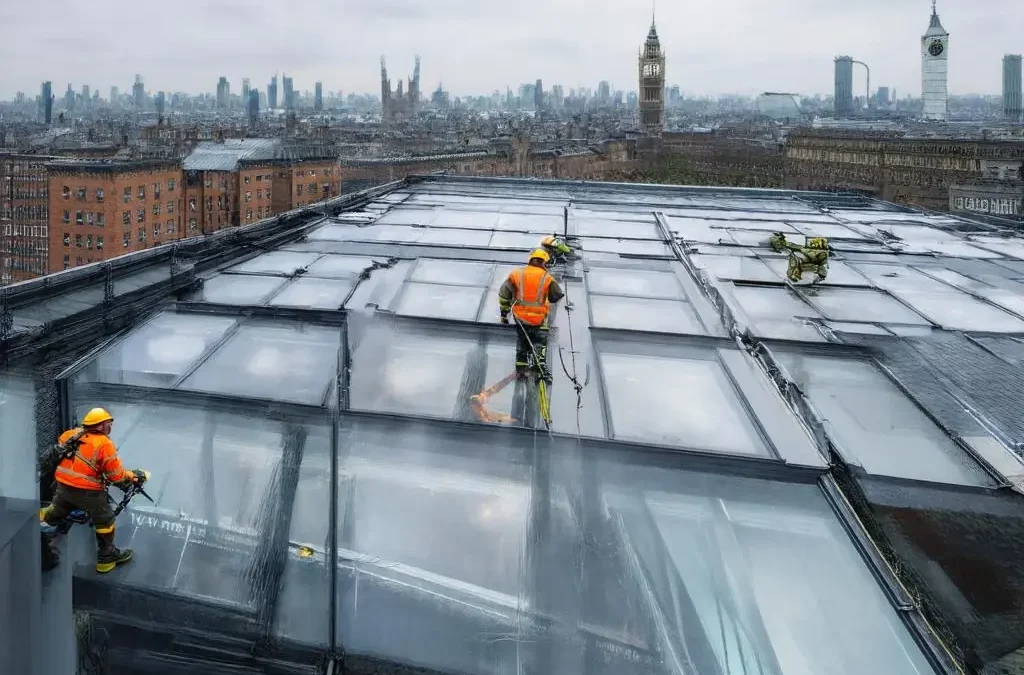
The global appetite for roof windows is accelerating through 2030. Developers and occupiers alike are seeking more natural light, improved ventilation and energy efficiency, while smart, automated glazing becomes standard across offices, retail, education and healthcare. For commercial property teams, the upside is clear: brighter interiors, healthier environments and reduced reliance on artificial lighting and mechanical ventilation. The operational implication, however, is that more overhead glazing demands more specialised maintenance to perform as designed.
Unlike vertical façades, roof windows and skylights collect airborne pollutants, organic debris and mineral deposits more quickly. They are also part of critical building envelopes, where failed seals or damaged flashing can compromise thermal performance and cause leakage. Smart units introduce additional elements—sensors, actuators, cables and control gear—that must be protected during cleaning. With portfolios across London and the South East increasing their roof glazing stock, the challenge is to manage condition and cleanliness proactively, safely and cost‑effectively.
Cleaning and inspection: protecting light, energy and watertightness
A professional maintenance regime delivers measurable benefits:
- Maximise daylight transmission: Even a light film of grime can reduce light transmittance significantly, dulling spaces and undermining the productivity and wellbeing benefits you installed roof glazing for in the first place.
- Maintain thermal performance: Dirt traps moisture and can accelerate degradation of coatings and seals. Clean panes and intact gaskets reduce cold bridging and condensation, supporting U‑values.
- Reduce leak risk: Routine inspection alongside cleaning identifies perished gaskets, cracked panes, blocked drainage channels, failed mastic and displaced flashing before they become costly ingress incidents.
- Preserve warranties and compliance: Many manufacturers stipulate cleaning methods, water quality and inspection intervals to maintain warranties. Documented maintenance also supports ISO‑aligned quality management and health and safety duties of care.
A structured approach pairs cleaning with condition checks. On each visit, competent technicians should visually survey glass, framing, gaskets, drainage paths and adjacent roof finishes; photograph issues; and report with remedial recommendations. Where smart systems are present, they should verify sensor housings and seals are intact and avoid overspray or impact on actuators and wiring. This dual focus—clean plus check—keeps performance high and life‑cycle costs low.
Safe access and cleaning methods: best practice for overhead glazing
Your choice of access method must be tailored to the building, roof form and height, and should always be determined by a formal risk assessment and method statement. In our experience across high‑rise and complex estates, the following techniques provide safe, efficient coverage:
- Water‑fed pole systems: From ground or roof level, telescopic poles deliver purified water to glazing, removing dirt without detergents and drying spot‑free. This minimises manual handling on the roof, protects specialist coatings and suits many atria, canopies and low‑slope installations.
- Rope access (abseiling): For high‑rise or intricate roofscapes without cradle coverage, IRATA‑trained technicians can access units efficiently while keeping equipment footprints low. Rope access is highly adaptable and often cost‑effective where other plant would be disruptive.
- Cradles and BMUs: Permanent or temporary building maintenance units provide stable, repeatable access for extensive rooflight runs or very tall structures. They allow systematic cleaning and detailed inspection, especially when combined with close‑quarter lighting for condition surveys.
- Mobile elevating work platforms (MEWPs): Booms and scissors provide flexible reach for mid‑rise units and complex geometries, often enabling out‑of‑hours deployment to minimise occupant disruption.
Regardless of access, purified water cleaning is the benchmark. Using de‑ionised water prevents mineral spotting, avoids residue that can attract further dirt, and eliminates chemical interactions with low‑E or self‑cleaning coatings. Soft brush heads and non‑abrasive pads protect glass and frames. Technicians should work from clean to dirty areas, maintain controlled rinse flows to avoid inundating gaskets, and keep water away from sensor housings and electrical components.
Critical elements to safeguard include:
- Gaskets and seals: Avoid aggressive jetting and point loads on perimeter seals. Any signs of perishing, detachment or compression set should be logged for replacement.
- Flashing and interfaces: Inspect for cracks, lifting edges and failed sealant at abutments; ensure debris is cleared from laps and terminations.
- Drainage channels and weeps: Clear blockages to prevent standing water and capillary action.
- Sensors and actuators: Mask or isolate as needed; never lever windows manually on automated systems; confirm weather stations and rain sensors are clean and secure.
Work sequencing should be coordinated with building operations and weather windows. Cleaning is most effective in cool, overcast conditions that reduce rapid drying and spotting risk. In occupied buildings, schedule for early mornings, evenings or weekends to mitigate disruption in retail and education settings, and to align MEWP use with site logistics. Where roofs integrate PV arrays, consult electrical isolation protocols and exclusion zones.
Frequencies and integration: making a plan that works portfolio‑wide
Cleaning frequency is not one‑size‑fits‑all. Set intervals based on objective environmental and design factors:
- Pollution load: Urban sites near arterial roads, rail corridors or construction zones accumulate soot and particulates faster. Increase frequency to monthly or bi‑monthly during peak activity.
- Coastal and industrial exposure: Salt spray and industrial fallout accelerate corrosion and film build‑up; monthly or quarterly cycles may be appropriate.
- Roof pitch and geometry: Low‑slope or flat units retain standing water and debris longer than steeply pitched skylights; complex mullion patterns trap dirt at junctions.
- Orientation and microclimate: North‑facing panes can harbour biofilm; sheltered courtyards may collect leaf litter; wind‑scoured ridges may stay cleaner.
- Usage and image requirements: Retail flagships and public spaces often warrant higher presentation standards than plant rooms or back‑of‑house areas.
A pragmatic baseline for many London commercial properties is quarterly to bi‑annual cleaning, with monthly inspections in high‑risk locations. After the first year, refine the schedule using luminance readings, soiling observations and leak‑call data.
Efficiency improves when you integrate roof glazing into wider fabric maintenance:
- Combine roof window cleaning with façade, atrium and canopy cleaning in a single visit, using shared access (cradle drops, MEWP placements, rope access rigging) to reduce mobilisation costs.
- Fold in gutter and roof drainage clearance to prevent overflow onto glazing and seals.
- Align with statutory inspections (lightning protection, fall arrest systems) to minimise roof access events and keep permit‑to‑work administration lean.
- Coordinate with BMS or facilities teams to disable automated opening during works and to verify post‑clean functionality of sensors and actuators.
For multi‑site portfolios, a planned maintenance matrix that tags each property’s exposure category, access method, and cleaning interval helps you allocate budget predictably and demonstrate governance.
Competence, compliance and cost‑effectiveness: what good looks like, plus a practical checklist
Specialist overhead glazing requires equally specialist teams. Look for demonstrable competence and documented controls:
- Training and accreditation: Technicians should be trained in water‑fed systems, MEWP operation (IPAF), rope access (IRATA), and site safety. Supervisors should hold relevant qualifications for work at height and first aid.
- Certified management systems: ISO 9001 (quality), ISO 14001 (environmental) and ISO 45001 (occupational health and safety) underpin consistent delivery, responsible waste and water management, and robust risk controls.
- Third‑party verification: SafeContractor approval and membership of professional bodies such as BICSc and the Federation of Window Cleaners evidence adherence to industry best practice.
- Method statements and reporting: Expect site‑specific RAMS, photographic reports, defect logs and sign‑off records that feed back into your asset management system.
As a seasoned provider serving London and the South East for over two decades, Efficient Cleaning Services applies this framework daily—deploying water‑fed poles, rope access, cradles and MEWPs to safely maintain overhead glazing on buildings of every height, while integrating roof windows with façade and external fabric cleaning to optimise cost and programme.
Practical checklist for property managers scoping, scheduling and auditing roof window maintenance:
- Asset register
- Catalogue all roof windows/skylights by type, location, size, pitch, access constraints and presence of smart/automated components.
- Risk and access planning
- Commission site‑specific risk assessments; define preferred access methods (poles, rope access, cradle, MEWP); verify anchor points, rescue plans and exclusion zones.
- Method and specification
- Specify purified water cleaning; set brush/pad types; include protection measures for coatings, gaskets, flashing, sensors and actuators; define inspection checklist items (glass, seals, drainage, interfaces).
- Scheduling
- Assign cleaning frequencies based on pollution load, exposure and business criticality; coordinate with façade/atrium cleaning, gutters and statutory inspections; plan around operational hours and weather windows.
- Compliance and credentials
- Require ISO 9001/14001/45001 certifications; verify SafeContractor status and relevant trade memberships; confirm technician training (IPAF, IRATA, first aid, work at height).
- Communication and permits
- Establish permit‑to‑work processes; notify stakeholders (FM, security, tenants); agree isolation of automated openings and BMS notifications; set up access routes and lifting plans for MEWPs/plant.
- Environmental controls
- Use closed‑loop or controlled run‑off where needed; avoid detergents unless manufacturer‑approved; manage waste debris responsibly.
- Quality assurance
- Capture before/after photography; record lux readings in critical areas if applicable; log defects and assign follow‑up works; obtain signed completion reports.
- Performance review
- Benchmark call‑outs for leaks or faults; adjust frequencies based on soiling rates and interior daylight measures; review incident/near‑miss data to improve safety and efficiency.
By adopting this structured, standards‑led approach—and partnering with competent, accredited specialists—you will protect the investment your organisation is making in roof glazing, sustain the health and energy benefits it is meant to deliver, and control total cost of ownership across your estate.
Recent Comments