
Facilities teams often reach for an all‑purpose cleaner for convenience. On interior glass and in small, low‑risk areas, a diluted, compatible all‑purpose product can be serviceable for quick touch‑ups. However, it is rarely the best choice for large commercial glazing, exterior façades, or height work.
The main issue is residue. Many general cleaners contain surfactants that leave a microscopic film, leading to streaks, spotting, and rapid re‑soiling as airborne contaminants cling to the surface. Over time, this can undermine the appearance of reception areas, retail frontages, and office atria—precisely where a pristine finish matters most.
Compatibility matters just as much. Certain formulas can degrade or stain:
- Window films, including solar‑control and privacy laminates
- Low‑E and hydrophobic coatings
- Perimeter seals and gaskets
- Anodised or powder‑coated frames
- Adjacent materials such as natural stone, render, and timber
These risks are amplified on expansive glazing and complex façades, where over‑application, overspray, and difficult access increase the chance of residues and run‑off. In short: an all‑purpose cleaner can be a stopgap for minor interior spots, but it is not a best‑practice approach for commercial building glass care.
What To Use Instead for Commercial Glass
For routine interiors
- Choose a non‑abrasive, ammonia‑free, neutral‑pH solution formulated for glass. This minimises the chance of damaging coatings, sealants, or frames while reducing residue.
- Use clean microfibre cloths for application and detailing. Microfibre captures fine particles without scratching.
- Finish with a professional squeegee pass. This removes remaining solution in a controlled way, reducing streaking and improving clarity.
For exterior panes and height work
- Use purified water (DI/RO) delivered via water‑fed poles. Deionised or reverse‑osmosis water dries spot‑free because it contains no dissolved minerals to leave deposits. It also leaves no detergent residue, helping glass stay cleaner for longer and supporting environmental objectives by reducing chemical use.
- Reserve detergents for heavy build‑up. When façades are contaminated with traffic film, construction dust, or organic soiling, a compatible detergent can be employed—but always followed by thorough rinsing with purified water to remove all residues.
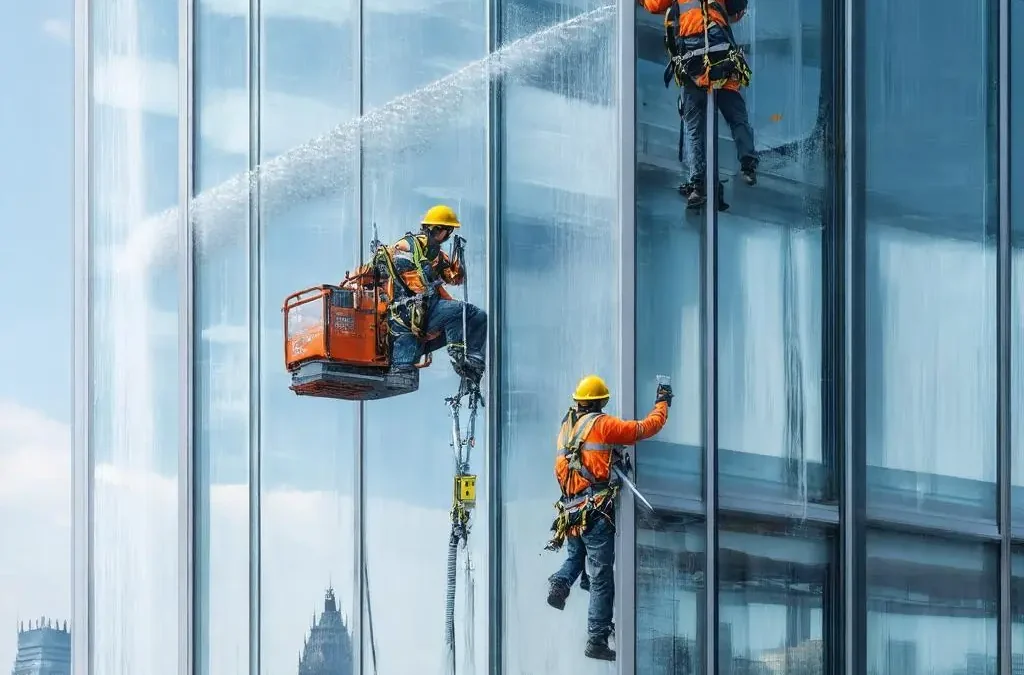
- Select the right access method. Water‑fed poles are ideal up to several storeys and eliminate much work at height. For taller or more complex structures, options include abseiling (rope access), cradles, and mobile elevating work platforms. Using the appropriate system reduces risk and improves efficiency while protecting façades.
The result is a consistent, streak‑free finish, fewer call‑backs, and a cleaning approach aligned with sustainability goals.
Pre‑Cleaning Risk Checks Every Site Should Complete
Before any glass cleaning—especially where warranties, specialist glazing, or height access are involved—complete the following checks:
- Identify glass and coatings. Confirm if panes have low‑E, hydrophobic, or other specialist coatings; note any applied films. Different surfaces demand different methods and chemistry.
- Review building and manufacturer warranties. Many warranties specify what can and cannot be used. Non‑compliance can void coverage.
- Test first. Trial your chosen method and dilution in a small, inconspicuous area and check for adverse effects after drying.
- Avoid abrasives and extremes. Do not use abrasive pads, strong acids or alkalis, or unverified solvents. These can scratch or etch glass, haze coatings, and degrade seals.
- Prevent overspray and run‑off. Mask sensitive materials, protect floors and carpets, and avoid exposing anodised frames and natural stone to detergents. Plan for wind direction and drainage.
- Never mix chemicals. Incompatible mixtures can generate hazardous reactions and fumes. Follow product safety data sheets and COSHH requirements.
- Work in cool, shaded conditions. Direct sun and hot glass accelerate drying, increasing streaking and chemical concentration on the surface. Aim for controlled application and removal.
These steps help protect the building fabric, safeguard warranties, and set the stage for a predictable, high‑quality finish.
Process Guidance: From Inspection to Sign‑Off
A professional, repeatable process is the foundation of consistent results across portfolios and multi‑site contracts:
- Pre‑inspection and risk assessment. Survey glazing types, access constraints, adjacent finishes, and drainage. Produce method statements and, where applicable, work at height plans compliant with the UK Work at Height Regulations and site rules.
- Dry removal first. Use soft brushes or dry microfibre to lift loose grit and dust. Dry cleaning reduces the chance of dragging particles that can scratch or haze the glass.
- Controlled application. Apply the chosen solution sparingly, at the correct dilution, to avoid flooding edges where seals and frames could be affected. Allow appropriate dwell time without letting the solution dry on the pane.
- Professional squeegee technique. Work top‑to‑bottom with even pressure and deliberate strokes. Wipe blade edges between passes to prevent tracking. Detail edges with a clean, lint‑free microfibre to remove any remaining moisture.
- Edge detailing and frame care. Inspect seals and frames for residue. Immediately remove any drips with a damp, neutral‑pH cloth followed by a dry buff.
- Floor and public protection. Use floor coverings, drip trays, and clear slip‑hazard signage. Manage pedestrian routes during works to prevent slips and trips.
- Wastewater and environmental control. Capture or divert run‑off to approved drains; do not allow contaminated water to enter surface water systems. Choose low‑impact products and document environmental controls to support ISO 14001 objectives.
- Access safety and equipment integrity. For water‑fed poles, confirm DI/RO water quality and equipment condition. For abseil, cradle, or platform works, ensure operator competence, current equipment inspections, and rescue plans. Align with ISO 45001 approaches to occupational health and safety.
- Quality assurance. Use defined standards for finish (e.g., daylight visible inspection), sign‑off checkpoints, and periodic auditing consistent with ISO 9001 quality management.
Following a disciplined method delivers uniform outcomes across different elevations, glazing types, and weather conditions, reducing rework and protecting assets.
When To Engage Specialists—and Why It Pays
Using an all‑purpose cleaner can be acceptable for occasional, diluted, interior spot‑cleaning when compatibility is confirmed. Beyond that, the costs of streaks, residue, coating damage, or warranty issues can quickly outweigh any convenience.
For dependable, streak‑free results—especially on high‑rise offices, retail frontages, and complex façades—specialist methods and trained operatives are the safest route. Efficient Cleaning Services brings two decades of commercial window cleaning experience across London and the South East, operating year‑round with access solutions for buildings of virtually any height. Our capabilities include:
- Purified water systems via water‑fed poles for spot‑free exterior glass
- Abseiling, ladder and cradle access, and mobile platforms for complex structures
- External building and façade cleaning to complement glazing works and maintain a coherent corporate image
Our approach is grounded in safety, certified quality, and environmental stewardship:
- ISO 9001 for quality management, ISO 14001 for environmental management, and ISO 45001 for occupational health and safety
- SafeContractor approval and affiliation with professional bodies including BICSc and FWC
- A proactive, compliance‑led ethos with tailored solutions for each site, backed by robust recruitment, training, and communication to protect the public and our teams
If you are assessing the right cleaning methodology for your buildings, we can help you select the safest, most cost‑effective option—whether that is neutral‑pH interior maintenance, purified water systems at height, or a combined programme that addresses glazing, frames, and façades together.
To discuss your portfolio or request a free, no‑obligation quote, contact our team via our website. We will be pleased to conduct a site assessment and propose a specification that delivers long‑lasting clarity, protects building assets, and supports your compliance and sustainability objectives.
Recent Comments