
Consumer tests of household cleaning machines routinely stress a handful of practical factors: how often you need to clean, how long surfaces take to dry, the noise you must tolerate, where to store equipment, how heavy it is to move, and whether it is better value to rent or bring in a specialist. The same questions apply—amplified—when you are responsible for exterior glass and façade maintenance across a retail estate or office portfolio.
- Cleaning frequency: High footfall frontages accumulate grime, fingerprints and airborne pollutants quickly. While quick spot cleans keep entrances presentable, deep cleans are required on a planned cycle to restore clarity and protect materials.
- Drying time: Wet façades and pavements create slip risks and disruption. Choice of method, timing, and weather window matters as much as the cleaning itself.
- Noise: Jetting and platform operations can affect trading floors, meeting rooms, and neighbours. Out-of-hours working and quiet methods (such as pure-water pole systems) reduce complaints.
- Storage and weight: Water-fed poles, deionisers, harnesses, cradles and MEWPs are bulky and heavy. Storing, maintaining and transporting them on site has real operational implications.
- Rent vs hire a specialist: Short-term kit rental can appear attractive, but competence, insurance, statutory inspections, rescue capability and programme certainty usually determine the smarter route.
This guide translates those “consumer test” lessons for facilities leaders responsible for London and South East properties, showing how to decide between renting, buying, or hiring certified specialists—and how to run a safe, efficient deep-clean programme that stands up to audit.
When Are Spot Cleans Enough—and How Often to Deep Clean?
Not every pane requires a full intervention. A sensible regime distinguishes between:
- Spot cleans: Fast, localised attention to handprints on doors, low-level smears, and emergency spills. These are typically handled by day janitors or mobile teams using spray, microfibre and squeegee. Aim for daily or as needed on busy frontages.
- Deep cleans: Systematic removal of accumulated pollutants, mineral deposits, traffic film and organic growth on glazing, frames and cladding. This resets appearance standards, reduces corrosion risk, and aids warranty compliance.
As a rule of thumb:
- Schedule deep cleans every 6–12 months for most façades.
- Increase frequency to quarterly for prestige entrances, transport-adjacent frontages, hospitality venues, and food retail where presentation drives revenue.
- Reduce to annual for upper storeys with low pollution exposure—provided interim spot cleans manage visible issues.
Season and weather matter. Pollen and dust in spring, traffic film in summer, leaf tannins in autumn, and de-icing residues in winter affect timing. Plan works to avoid freezing conditions and high winds; build flexibility into the programme to shift slots without compromising safety or trading. Always allow for drying time to prevent slip hazards—particularly on polished stone and tiled approaches.
Matching Height, Design and Risk to the Right Access Method
The optimum access method depends on geometry, height, public interface, and façade materials. Good planning balances reach, productivity, environmental impact, and risk.
-
Water-fed poles (WFP): Deionised “pure-water” systems deliver streak-free results up to approximately 20 metres from ground level. Benefits include rapid deployment, low noise, minimal chemicals, and reduced pavement disruption. Ideal for mid-rise glazing, atria edges, canopies and solar shading. Requires attention to runoff management and pedestrian segregation.
-
Rope access (abseiling): Highly efficient for complex façades, set-backs and high-rise where cradles are absent or impractical. Enables precise work with minimal ground footprint. Demands a robust risk assessment, competent technicians, rescue plans, anchor inspections, and wind/weather thresholds. Particularly useful in dense urban streetscapes where MEWP placement is constrained.
-
Cradle access/BMUs: Permanent building maintenance units or temporary cradles offer stable platforms for extended works, heavy tooling, and facade restoration. Pre-use checks, statutory inspections (e.g., under LOLER where applicable), and coordination with building management are essential. Excellent for uniform curtain walling and large floor plates.
-
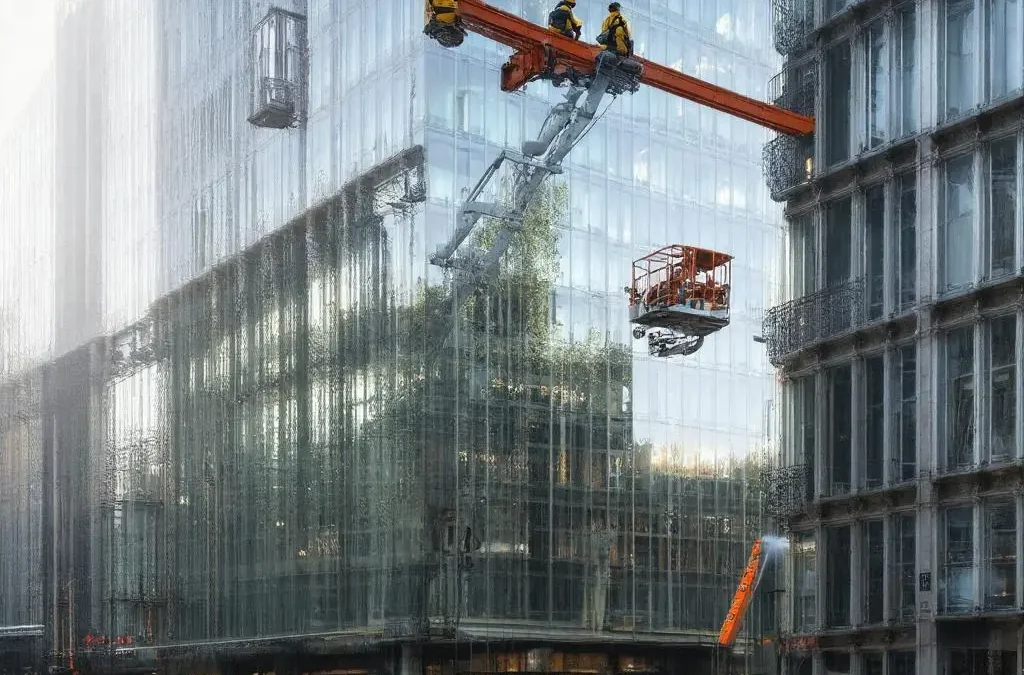
Mobile elevating work platforms (MEWPs): Truck- or self-propelled units provide flexible reach for elevations and soffits. They require ground bearing checks, exclusion zones, competent operators, and often parking suspensions or local authority permits. Best where street width and loading allow safe deployment.
The plan must reflect:
- Risk assessment and method statements (RAMS), including rescue procedures and exclusion zones.
- Weather thresholds (wind, lightning, driving rain, temperature) specific to the access method.
- Permits and stakeholder approvals: local authority licences for pavement/road occupation, building security protocols, landlord approvals, and neighbour notifications.
- Material sensitivity: anodised aluminium, natural stone and coated glass may require low-impact detergents, soft-bristle brushes, or pure-water-only approaches to avoid etching and streaking.
A brief site survey that captures anchors, cradle availability, street constraints, drainage, and public flow will determine the safest and most efficient approach.
Rent, Buy or Hire: The Real Cost and Compliance Equation
At first glance, buying or renting equipment can appear cost-effective. However, the total cost of ownership (TCO) and the compliance burden often tip the balance in favour of engaging certified specialists—especially for multi-storey or high-footfall sites.
If you buy or rent to self-deliver, budget for:
- Competence and training: Work at height, WFP handling, MEWP operation, harness use, rescue drills, and refresher training; time off the job and certification costs.
- Inspections and compliance: LOLER/PUWER where applicable, anchor point testing, PAT testing for electrical kit, and documented RAMS for each job.
- Rescue planning: Practical, rehearsed procedures for rope access or MEWP incidents, with sufficient competent personnel on each shift.
- Insurance: Public and employers’ liability at suitable limits for high-risk work; potential premium uplifts for rope access/MEWP operations.
- Maintenance and consumables: Filter media for pure-water systems, brush heads, hoses, squeegees, PPE, detergents, and periodic equipment overhaul.
- Storage and logistics: Secure, ventilated storage for chemicals and kit; vehicle capacity and parking provisions; handling and manual lifting risks.
- Supervision and audit: Competence management, permit coordination, photographic records, and close-out reporting to satisfy internal and external audits.
- Business continuity risk: Weather cancellations, staff illness, equipment failure, and the management time required to reprogramme works without affecting trading.
By contrast, hiring a qualified contractor provides predictable outputs and cost certainty:
- Fixed programme pricing aligned to your service level, with contingency planning for weather and out-of-hours delivery.
- Assured competence and safety culture backed by independent certifications (for example, ISO 9001 quality management, ISO 14001 environmental management, and ISO 45001 occupational health and safety).
- Third-party accreditations such as SafeContractor and membership of professional bodies (e.g., BICSc, FWC) that add assurance on training, methods and ethics.
- Scalable access capability—water-fed poles, rope access, cradles and MEWPs—matched to each elevation and season.
- Comprehensive documentation: RAMS, permits, anchor certificates, pre- and post-clean photos, and environmental records ready for your audit trail.
For facilities across London and the South East, a specialist such as Efficient Cleaning Services brings two decades of high-rise and complex-access experience, year‑round operations, and a proactive approach to programme design and risk control. This typically reduces whole-life cost compared with maintaining an in‑house capability, and materially lowers residual risk.
A balanced decision framework:
- Low-rise, low-risk, low-footfall: Renting light WFP kit for occasional in-house use may be viable if your team is trained and insured, and you can segregate the public.
- Multi-storey, high-footfall, architecturally complex: Hiring a certified specialist is usually the safest, most economical route, with less disruption and better auditability.
- Portfolio view: Where consistency of appearance and reporting is key, a single specialist partner offers standardised methods, metrics and documentation across sites.
Operational Best Practice, Practical Checklist and KPIs
Once you have chosen the delivery route, disciplined execution protects safety, brand image and budgets.
Operational tips:
- Pre-clean preparation: Remove loose debris, inspect for damaged seals, flaking paint, or failed gaskets; pre-wet sensitive materials to minimise staining; test a small area where finishes are unknown.
- Protect the public realm: Install barriers and clear signage; create exclusion zones beneath work areas; deploy spotters on busy pavements.
- Minimise disruption: Schedule out-of-hours or early-morning works for entrances and retail frontages; coordinate with tenant peak times and deliveries.
- Manage runoff and drying: Use low-flow methods, wet-vacs, drip trays or silt socks; direct runoff away from entrances; squeegee pavements and place additional mats to reduce slip risk; confirm drying times before re‑opening areas.
- Choose low-impact chemistry: Prefer pure-water systems for glass to reduce streaking and residue; where detergents are necessary, use biodegradable, pH‑neutral products compatible with façade materials; maintain COSHH documentation.
- Noise and neighbourliness: Use quieter methods where possible; communicate schedules to occupants and neighbours; monitor noise at agreed thresholds.
- Documentation: Capture before/after images, access equipment checks, weather logs, and completion reports to feed your audit trail.
Practical planning checklist:
- Site survey completed with elevation-by-elevation access plan.
- RAMS approved, including rescue plans and wind/weather thresholds.
- Permits and licences secured (local authority, building, landlord).
- Public protection plan in place (barriers, signage, spotters).
- Environmental controls defined (runoff capture, chemical selection, waste disposal).
- Programme and contingencies agreed (out-of-hours windows, alternates).
- Competence verified (training records, certifications, insurances).
- Equipment inspected and compliant (anchors, cradles, MEWPs, WFP).
- Communications issued to stakeholders (tenants, security, neighbours).
- Evidence capture set up (photos, checklists, sign-offs).
KPI ideas to assure quality, safety and compliance:
- Appearance standards: Percentage of panes passing visual clarity tests; number of defects per elevation; tenant satisfaction scores post‑clean.
- Safety metrics: Zero RIDDOR events; near-miss reporting rate and close-out actions; adherence to wind-speed cut-offs; barrier compliance checks.
- Programme performance: On-time completion rate; rework rate within 7 days; mean time to remediate urgent call-outs.
- Environmental performance: Chemical-free clean percentage; litres of water used per 100 m²; waste and runoff capture compliance.
- Audit trail completeness: RAMS on file; permits logged; photo evidence attached; anchor and equipment inspection certificates current.
If you require a predictable, compliant programme across single or multiple sites—particularly for high-rise or complex façades—engaging a certified specialist is typically the most effective option. For organisations in London and the South East, Efficient Cleaning Services combines water-fed pole systems, rope access, cradles and mobile platforms with ISO 9001/14001/45001 management systems, SafeContractor approval and professional affiliations (BICSc and FWC). We operate year-round, deliver out-of-hours where needed, and provide clear documentation and KPIs to help facilities teams demonstrate value and compliance. To discuss a tailored plan or request a free, no‑obligation quote, please get in touch.
Recent Comments