
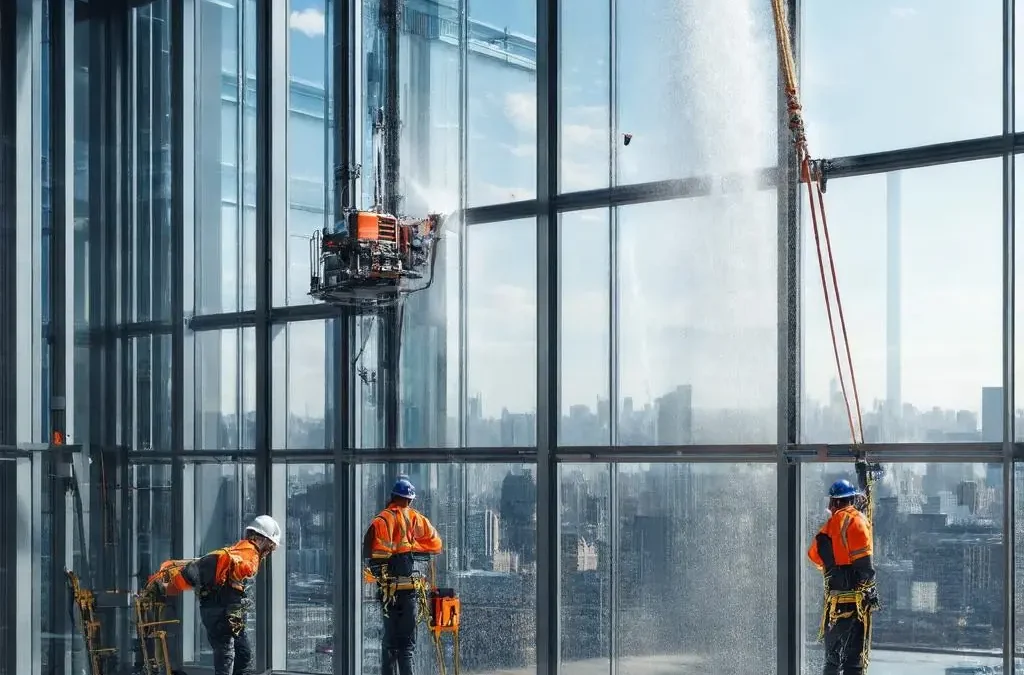
For facilities managers responsible for retail units, office blocks, and high-rise commercial buildings, selecting a window cleaning contractor is not a task that should begin and end with local listings or classified adverts. While such directories may present a wide range of providers under one heading, they rarely reflect the operational complexity, safety demands, and compliance requirements involved in maintaining modern commercial properties.
In practice, commercial window cleaning is far more than a routine aesthetic service. Clean glazing and well-maintained façades contribute directly to a building’s presentation, tenant satisfaction, visitor perception, and overall asset value. For office environments, external appearance supports corporate image; for retail premises, it can influence customer impressions from the street. However, once buildings increase in height, footprint, or portfolio spread, the procurement process must become more rigorous.
A suitable contractor for high-rise and multi-site properties must demonstrate not only the ability to clean windows effectively, but also the competence to plan access safely, protect members of the public, work around live commercial environments, and maintain consistent standards across every location. This is especially important when access methods may vary from one site to another, or where year-round delivery is required despite weather changes, restricted operating hours, or complex façade design.
Rather than selecting a provider on convenience or price alone, facilities managers should treat window cleaning procurement as a compliance-led, performance-based decision. The goal is to move from a long list of generic adverts to a qualified shortlist of contractors with the systems, experience, and operational discipline to deliver safely and reliably.
2. The Criteria That Matter Most When Building a Qualified Shortlist
The first area to examine is compliance. Any contractor under consideration should be able to provide clear evidence of independently audited management systems covering quality, environmental responsibility, and occupational health and safety. These systems show that the provider is operating to recognised standards rather than relying on informal or inconsistent practices. Facilities managers should also verify adequate public liability and employer’s liability insurance, alongside documented risk assessments and method statements for the works being proposed. If a company cannot produce these promptly and clearly, it should not progress further in the selection process.
The second critical factor is access capability. Commercial estates rarely present a one-size-fits-all cleaning requirement. Some sites may be suited to water-fed pole systems, while others may require rope access, cradles, ladders, or mobile elevating work platforms. A capable contractor should be able to explain which methods are appropriate for each building, why they are suitable, and what limitations or safety controls apply. Just as importantly, they should have demonstrable experience working across a range of building heights, layouts, and façade materials. This is particularly relevant for mixed portfolios where a contractor may need to service both lower-level retail units and taller office blocks under one agreement.
Safety culture is equally important and should go beyond statements on a website. Facilities managers should look for evidence of formal training programmes, active supervision, regular toolbox talks, incident reporting procedures, permit-to-work systems where required, and practical controls such as exclusion zones and public protection measures. A strong safety culture is visible in how a contractor plans and communicates work, not simply in how they describe themselves. For occupied buildings and busy public-facing environments, this is essential.
Quality control must also be robust. The best providers do not rely on assumptions that a job has been completed to standard; they implement scheduled inspections, measurable KPIs, photographic reports where appropriate, digital job sheets, and transparent communication with clients. This creates accountability and gives facilities managers confidence that standards are being maintained consistently across all sites and service visits.
Environmental stewardship is another increasingly important consideration. Contractors should be prepared to explain how they minimise environmental impact through the use of pure-water systems, wastewater control, responsible chemical management, and recycling practices. For many organisations, environmental performance is now linked to broader corporate governance and sustainability targets, making this a practical procurement criterion rather than a secondary preference.
Cost transparency should be treated with equal seriousness. A credible quotation should follow a proper site survey and include a clearly defined scope of works, agreed cleaning frequencies, access assumptions, and any conditions affecting delivery. Facilities managers should be wary of unclear pricing structures, open-ended extras, or estimates issued without a detailed understanding of the site. Fixed schedules and clearly stated inclusions are essential for comparing suppliers fairly and managing budgets accurately.
Finally, operational flexibility and service breadth can significantly improve long-term value. Commercial buildings often require out-of-hours attendance, contingency planning for adverse weather, and rapid response support when urgent cleaning issues arise. In addition, a contractor that can integrate window cleaning with façade and external building cleaning may offer practical efficiencies, fewer points of contact, and a more coordinated approach to exterior maintenance.
3. A Practical Procurement Process for Facilities Managers
A structured procurement process helps ensure that the final appointment is based on evidence rather than assumptions. The first step is to define your objectives and access constraints clearly. Facilities managers should identify what success looks like across the portfolio: presentation standards, cleaning frequencies, operational windows, public interface risks, and any specific access restrictions at each site. Without this clarity, quotations may vary widely and become difficult to compare on a like-for-like basis.
The second step is to request evidence of competence and training. This should include details of workforce qualifications, experience with similar commercial buildings, supervision arrangements, and ongoing training records. It is particularly important to confirm that operatives are competent in the access methods likely to be used across your sites.
Thirdly, ask for a site-specific access plan. Rather than accepting a generic statement that the contractor can work at height, request a practical explanation of how each building will be serviced. The plan should identify proposed access methods, public protection measures, potential operational challenges, and contingency arrangements. This is where experienced providers distinguish themselves from more limited operators.
The fourth step is to verify certifications and insurance levels. Do not assume that logos in marketing materials are current or applicable. Ask for up-to-date certificates, insurance schedules, and evidence of independently audited systems. Verification at this stage can prevent significant risk later in the contract.
Fifthly, trial a pilot clean. Before committing to a full rollout across multiple sites or a long-term agreement, a pilot clean can provide valuable insight into punctuality, communication, workmanship, reporting quality, and site behaviour. It also allows both parties to refine expectations before service begins at scale.
The sixth step is to set SLAs and reporting standards. Service level agreements should define attendance windows, quality expectations, escalation routes, reporting frequency, KPIs, and any documentation required after each visit. This ensures accountability and reduces ambiguity once the contract is active.
Finally, review performance quarterly. Even strong contractors benefit from structured review meetings. Quarterly assessments allow facilities managers to evaluate service consistency, safety performance, communication quality, issue resolution, and any evolving site requirements. This approach supports continuous improvement and helps maintain standards over time.
4. Red Flags That Should Prompt Caution
There are several warning signs that facilities managers should treat seriously during the selection process. One of the most common is vague insurance information. If a contractor is unclear about policy levels, reluctant to provide documentation, or unable to explain what their cover includes, this should raise immediate concern.
Another major red flag is the absence of method statements or risk assessments. High-rise and commercial window cleaning cannot be delivered safely on the basis of informal understanding. Documentation is not administrative excess; it is part of the safe system of work.
Lowest-price-only bids should also be approached cautiously. A quotation that appears significantly below the market rate may reflect omissions in scope, inadequate supervision, insufficient access capability, or weak compliance standards. In commercial property maintenance, a low initial price can quickly become expensive if service failure, safety issues, or unplanned extras follow.
Facilities managers should also be wary of contractors with no relevant references, particularly for buildings of comparable height, use, or complexity. A provider may be competent in small-scale domestic or low-level work yet be unsuited to a larger commercial portfolio.
Limited access capability is another clear warning sign. If a contractor can only offer one access method regardless of building type, they may not be able to service the full estate safely or efficiently. Commercial portfolios require flexibility, not a forced fit.
Selecting the right commercial window cleaning partner for high-rise and multi-site properties means looking beyond adverts and focusing on competence, systems, and proven delivery. The strongest contractors combine compliant operations, specialist access capability, a genuine safety culture, transparent reporting, environmental responsibility, and the flexibility to support year-round property maintenance. If you are reviewing providers for retail units, office blocks, or complex commercial buildings, arrange a free site survey and quote to ensure your chosen partner can deliver safe, consistent, and high-quality results across every site throughout the year.
Recent Comments