
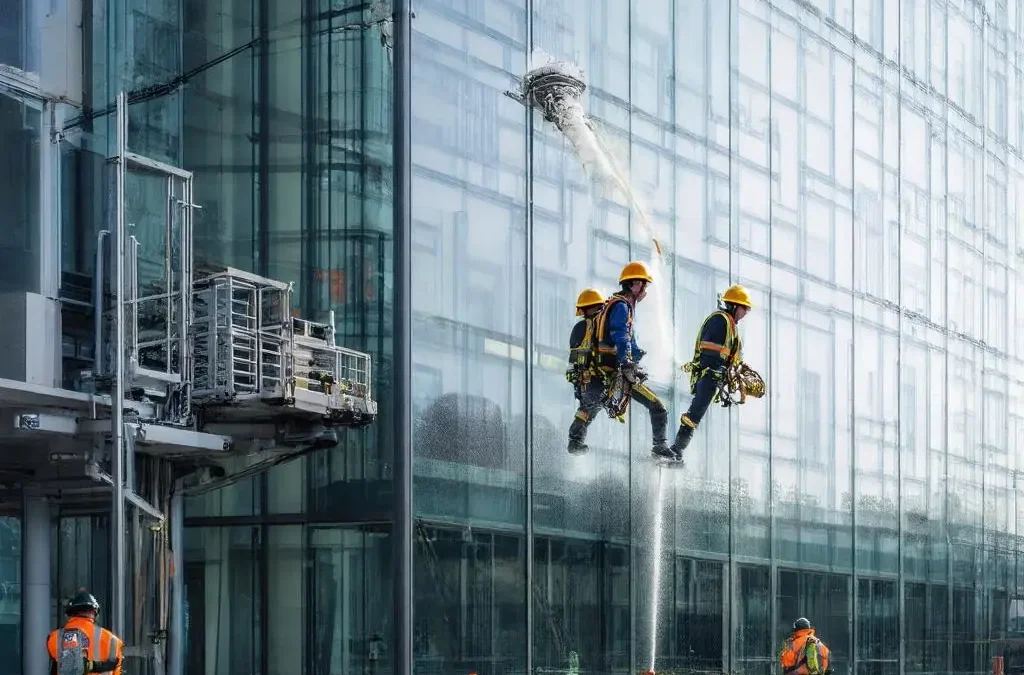
Community classifieds and local boards are awash with window cleaning and pressure‑washing offers. That abundance signals strong demand; it also signals widely varying standards. For commercial estates, retail parks, office blocks and high‑rise buildings, picking on price alone is a false economy. The consequences of poor selection range from disrupted operations and reputational damage to avoidable safety incidents and uninsured liabilities.
Facilities and property managers need a clear, defensible framework that translates “we clean windows” into verifiable competence, compliance and value over the long term. The following practical approach enables you to compare like‑for‑like, probe beyond marketing claims, and move from ad‑hoc callouts to a safe, reliable, year‑round partnership.
A practical selection framework: eight essentials to require and verify
1) Compliance and safety
Insist on written, site‑specific documentation and evidence that day‑to‑day practices reflect the law.
- Risk assessments and method statements (RAMS) prepared for your building(s), not generic templates.
- Demonstrable compliance with the Work at Height Regulations 2005, including hierarchy of control (avoid, prevent, mitigate).
- Evidence of regular equipment inspections and statutory examinations:
- LOLER 1998 for lifting equipment (e.g., building maintenance units/cradles, harness attachment points, rope access kit).
- PUWER 1998 for work equipment (e.g., water‑fed pole systems, pressure washers).
- Documented PPE inspections at intervals appropriate to the equipment and standards.
- Permit‑to‑work procedures, exclusion zones, and traffic/pedestrian management plans where applicable.
- Weather thresholds for safe operation (e.g., wind speed limits for rope access, cradles and mobile elevating work platforms).
2) Independent assurance
Look beyond self‑declarations. Third‑party verification signals mature systems you can audit.
- Certification to recognised management standards:
- ISO 9001 (quality management) for process control and continuous improvement.
- ISO 14001 (environmental management) for waste, water usage and chemical control.
- ISO 45001 (occupational health & safety) for hazard identification, consultation and leadership.
- Accreditation/approvals such as SafeContractor or equivalent SSIP scheme.
- Membership in relevant professional bodies (e.g., The British Institute of Cleaning Science, Federation of Window Cleaners).
- Willingness to share audit summaries, policy documents and certificate validity dates.
3) Insurance
Do not accept vague statements. Obtain certificates and check the detail.
- Employers’ Liability and Public Liability limits appropriate to your risk profile (often £10m PL for city‑centre, high‑footfall sites).
- Explicit height scope (e.g., “works at height up to [X] metres” or “no height restriction”) and permitted methods (e.g., rope access, cradle use).
- Confirm that key activities are not excluded (e.g., abseil/rope access, use of MEWPs, pressure‑washing of façades, use of purified water systems).
- Professional Indemnity where surveys and advisory work are provided.
- Written confirmation of cover for out‑of‑hours work.
4) Competence and access
You are buying safe access as much as glass cleaning. Confirm that the right method is chosen and competently delivered.
- Training and credentials aligned to method:
- Rope access: IRATA‑trained technicians with a level mix suited to the task and an IRATA Level 3 supervisor on complex works.
- MEWPs: IPAF certification for relevant categories, plus familiarisation for the specific machine.
- Cradles/BMUs: evidence of user training, rescue procedures and building‑specific induction.
- Water‑fed poles: training in safe use, handling, reach limits and ground hazard assessments.
- Ladders: used only where justified under WAHR, with demonstrated control measures and short‑duration tasks.
- Site‑specific rescue plans for rope access and cradle work, including drill frequency and records.
- A method selection matrix that explains when to use water‑fed poles, rope access, cradles or mobile platforms, considering building geometry, ground conditions, public interface, and façade materials.
- Access planning that factors in road permits, traffic management, crane/MEWP delivery routes and set‑down areas.
5) Scope and scheduling
Define “what, when and how often” to minimise disruption and avoid scope creep.
- Detailed schedule by elevation/zone, glazing type (vision glass, atria, canopies, balustrades, signage) and frequency.
- Inclusion/exclusion of internal glass, rooflights, solar shading, fins, and difficult‑to‑reach architectural features.
- Weather contingencies and make‑good provisions, including timelines for reattendance.
- Out‑of‑hours, weekend or early‑morning windows to avoid peak footfall and protect the customer experience.
- Communication plans with building management, security and retail tenants ahead of each visit.
6) Measurement and reporting
If you cannot measure, you cannot manage.
- Service Level Agreements (SLAs) and Key Performance Indicators (KPIs) that matter: attendance compliance, completion rate, defect rate, and response to non‑conformances.
- Digital attendance logs (e.g., QR/NFC checkpoints or GPS‑time‑stamped data) and electronic job sheets.
- Before/after images for exception areas, plus periodic quality audits documented with corrective actions.
- A client portal or monthly report pack summarising works completed, access method used, incidents/near misses, and sustainability metrics (e.g., water usage, detergent logs).
- Clear escalation paths and a named contract manager.
7) Costing
Transparent pricing enables fair comparisons and prevents variation disputes.
- A free site survey as standard, with elevation‑by‑elevation timings and the proposed access method for each area.
- Like‑for‑like pricing templates that break down labour hours, access equipment (hire vs. own), traffic management, water purification, mobilisation, inductions and out‑of‑hours uplifts.
- Identification of seasonal variables (e.g., leaf fall, coastal salt, construction dust) that may alter frequency or method.
- Value engineering options (e.g., pairing window cleans with planned façade washes to share access costs).
- Clear terms for cancellations, weather delays and reattendance.
8) Red flags to avoid
These are reliable predictors of poor performance and risk transfer to you.
- No documented RAMS or “copy‑and‑paste” paperwork not tailored to your site.
- Vague or outdated insurance certificates; “cash‑only” terms; reluctance to name insurers or brokers.
- Refusal to share training matrices, LOLER/PUWER inspection records or rescue plans.
- Quotations issued without a site visit for anything beyond simple, low‑rise jobs.
- No environmental policy, uncontrolled discharge of wastewater, or use of harsh chemicals incompatible with façade materials.
- Over‑reliance on ladders for tasks that clearly require safer alternatives.
When to combine window and façade cleaning for better results and value
Clean glass set against dirty cladding still reads as poor maintenance to visitors and occupiers. In many cases, integrating façade cleaning with your window cleaning programme delivers superior outcomes at lower total cost.
- Cleaner results: Pressure‑washing or soft‑washing façades before a window clean prevents dirty run‑off from streaking freshly cleaned glass. Plan sequencing accordingly: façade first, then glass.
- Shared access costs: Rope access rigging, cradle time or MEWP hire, traffic management and permits are major cost drivers. Combining works allows you to amortise these across multiple tasks.
- Reduced disruption: One coordinated mobilisation minimises exclusion zones, noise and out‑of‑hours working, improving the occupier experience.
- Material protection: Experienced contractors will select methods suited to substrate—low‑pressure rinsing and approved biocides for delicate stone; controlled pressure and fan tips for robust surfaces; detergent‑free purified water for glass—and will test on inconspicuous areas first.
- Sustainability: Integrated plans reduce repeat journeys and idle machine time, lowering carbon impact. Look for contractors with ISO 14001 to evidence environmental controls.
For multi‑storey assets and high‑rise towers, a provider competent across water‑fed poles, rope access, cradles and mobile platforms can tailor a blended approach by elevation and exposure, ensuring that both façade and glazing are addressed safely and economically year‑round.
From classifieds to contracts: a tender checklist you can use
To move from ad‑hoc offers to a robust partnership, run a structured mini‑tender or formal RFP. Require the following and assess submissions consistently.
- Company profile: years trading; geographic coverage; key clients in comparable sectors; 24/7/365 capability.
- Accreditations: copies of ISO 9001/14001/45001 certificates; SafeContractor/SSIP; memberships (e.g., BICSc, FWC).
- Insurance: current Employers’ Liability and Public Liability certificates with height scope and method inclusions; confirmation of Professional Indemnity if applicable.
- People and competence: organisation chart; training matrix (IRATA levels, IPAF categories, CSCS, first aid); sample toolbox talk; supervision ratios; vetting for sensitive sites if relevant.
- Methods and RAMS: site‑specific draft RAMS; method selection rationale per elevation; rescue plans for rope access and cradles; weather policy and thresholds.
- Equipment and inspections: inventory of owned equipment; evidence of recent LOLER and PUWER inspections; PPE inspection regime; water purification system details (for water‑fed poles).
- Programme and access planning: annotated site plans showing anchor points, cradle runs, MEWP positions, exclusion zones and traffic management; proposed frequencies; out‑of‑hours options.
- Quality and reporting: sample SLA/KPI schedule; quality audit template; digital attendance method; example monthly report with before/after images; non‑conformance process.
- Environmental controls: chemical data sheets; wastewater containment/disposal plan; noise/dust controls; sustainability initiatives.
- Price breakdown: like‑for‑like pricing by elevation/zone and frequency; access equipment hire rates; mobilisation and induction costs; reattendance terms; any volume discounts.
- References: two or three contacts for similar buildings; evidence of year‑round retention and performance.
- Contract terms: notice periods; change control; performance remedies; liability caps; social value commitments where required.
Review bids against a weighted matrix that prioritises safety, competence and service assurance over headline price. Conduct clarifications and, for shortlisted providers, request a supervised trial clean on a high‑risk elevation to validate the proposed method, supervision and reporting.
A credible partner will welcome scrutiny, provide complete documentation promptly, and offer constructive suggestions to improve safety and efficiency. In a crowded market, these are the markers of a company equipped for complex, high‑rise environments—not just the next advert on a noticeboard.
If your portfolio spans London and the South East, consider providers with year‑round operations, proven high‑rise capability across water‑fed poles, rope access, cradles and mobile platforms, and independent certification to recognised standards. That combination delivers the reliability, safety and certified quality management that protect your brand—and your building—long after the initial quote.
Recent Comments