
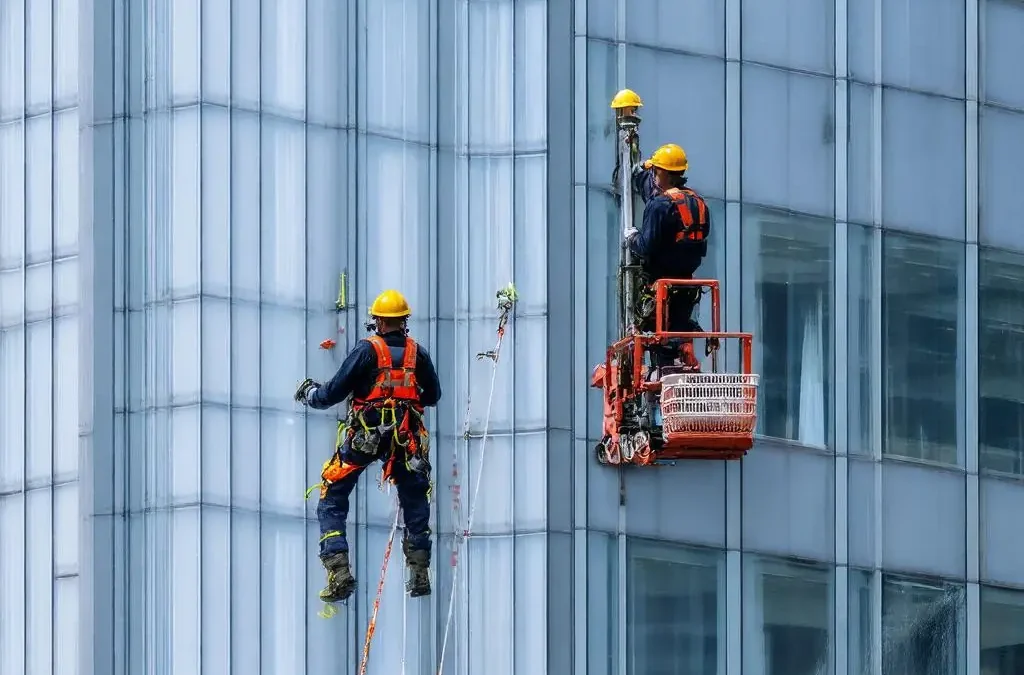
Low-cost digital tools, online marketplaces and modest cash infusions have lowered the barriers to launching service businesses across the UK. Window cleaning, pressure washing and painting are seeing a surge of new entrants offering quick quotes via apps and social media. For homeowners, the increased choice can be welcome. For commercial property teams—particularly those responsible for mid- and high-rise assets in London and the South East—the stakes are far higher.
At height, the margin for error narrows. The right supplier must demonstrate proven systems for safety, quality and compliance, not just enthusiasm and a ladder. This article explains what differentiates complex commercial window cleaning from residential work, how access methods should be selected, and what a rigorous buying and due diligence process looks like. It concludes with guidance on comparing quotes on total value—so you can leverage competition without compromising standards or lifecycle outcomes for your glazing and façades.
Commercial is not residential: what competence looks like at height
Cleaning a townhouse bay window and delivering a safe, compliant programme on a 20-storey office are fundamentally different disciplines. Competence in the commercial context rests on four pillars:
-
Work-at-height planning: Professional contractors develop job-specific plans aligned to the Work at Height Regulations. This includes selecting the safest reasonably practicable access method, sequencing work to minimise exposure, and scheduling to reduce disruption to occupants and the public realm.
-
Site-specific RAMS: Generic paperwork does not cut it. You should expect site-specific Risk Assessments and Method Statements (RAMS) that address building geometry, pedestrian flows, traffic interfaces, weather exposures, fragile surfaces, anchor systems, rescue plans and emergency egress.
-
Competent supervision: Trained, experienced supervisors coordinate teams, interface with building management, verify permits-to-work and dynamic risk assessments, and manage change when conditions shift on the day.
-
Documented equipment inspections: All access and lifting equipment must be maintained and inspected in line with UK law and manufacturer guidance (e.g., LOLER/PUWER where applicable) with records available on request. Rope access kits, MEWPs, cradles and PPE should have clear inspection regimes and traceability.
Effective commercial delivery also depends on management systems that institutionalise good practice: quality control, environmental management, incident reporting and corrective action. Independent certification provides assurance that these systems are real and audited—not just words on a website.
Choosing the right access method: safety, disruption and cost
No single access method suits every elevation or façade material. A competent contractor will often combine approaches across a site to achieve the safest and most efficient outcome.
-
Water-fed pole (WFP) systems
- Best for: Low to mid-rise elevations (typically up to ~20–25 metres, subject to site constraints), glass and frames that respond well to purified water, perimeter areas with secure ground conditions.
- Implications: Low-disruption and efficient for routine cleans; reduced need for chemicals; minimal set-up time. Requires trained operatives to manage public interfaces and prevent water run-off issues.
- Risks to manage: Trip hazards from hoses, wind loading at greater heights, water spotting if TDS control is poor, potential for run-off into sensitive planting or slip-prone surfaces without controls.
-
Rope-based techniques (abseiling/IRATA-style rope access)
- Best for: High-rise façades without permanent cradles, complex geometry, confined sites where MEWPs cannot be deployed, or where targeted access is required.
- Implications: Highly versatile with low ground footprint; minimal disruption when properly cordoned. Requires robust anchor testing/verification and a documented rescue plan.
- Risks to manage: Absolute reliance on technician competence and supervision; stringent equipment inspection regimes and weather thresholds; building permissions for anchor use.
-
Cradle access (permanent building maintenance units or temporary cradles)
- Best for: Buildings designed with BMUs; long, uninterrupted drops; façades requiring methodical coverage and predictable cycle times.
- Implications: Efficient for repeatable programmes; stable working platform; useful for additional façade maintenance tasks in combination with cleaning.
- Risks to manage: Thorough examinations and maintenance regimes; operator training; exclusion zones and communication protocols with building management.
-
Mobile elevating work platforms (MEWPs)
- Best for: Mid-rise elevations, atria, and locations where ground conditions and access routes allow safe deployment (e.g., car parks, service roads).
- Implications: Rapid access to targeted areas; controlled working environment. Requires competent operators and traffic/pedestrian management plans.
- Risks to manage: Ground bearing capacity, overhead obstructions, fuel/emissions considerations indoors, road permits if operating from public highways.
-
Ladders and step systems
- Best for: Short-duration, low-level tasks where safer alternatives are not reasonably practicable (e.g., internal glazing, restricted plant rooms).
- Implications: Strict time limits and three-point contact; often combined with other methods.
- Risks to manage: Tight procedural control and supervision to meet work-at-height best practice.
An experienced partner will justify access choices in your RAMS, explain implications for cost and programme, and adapt methods seasonally (for example, wind policies for rope access, or out-of-hours cleaning to avoid peak footfall).
The buyer’s checklist and due diligence: separating promise from proof
When the market gets crowded, your defence is a disciplined procurement process. Use this checklist to validate claims and reduce exposure:
-
Independent safety accreditations and affiliations
- Examples to look for: ISO 45001 (occupational health and safety), SafeContractor or equivalent SSIP accreditation, membership of relevant professional bodies such as FWC and BICSc.
- Why it matters: Demonstrates audited systems, not just ad hoc practices.
-
Evidence of training and competence
- Rope access: Technicians trained to recognised standards with logged hours; documented rescue competencies.
- MEWPs: Current IPAF cards for relevant categories.
- WFP systems: Training in safe set-up, water quality management and public interface control.
- Supervisors: IOSH/NEBOSH or equivalent safety qualifications; first-aid coverage on site.
-
Adequate insurance limits
- Verify employers’ liability and public liability appropriate to your risk profile (often £10m+ for high-footfall city-centre sites), plus evidence of cover for specific activities (rope access, MEWPs, cradles).
-
Environmental controls
- Water management: Purified water systems with TDS logs; run-off controls to avoid slip hazards and protect landscaping; containment where needed.
- Chemical stewardship: Compatibility with façade materials (stone, metals, sealants, coated glass); COSHH assessments; spill kits and waste disposal procedures.
- ISO 14001 certification as evidence of a structured environmental management system.
-
Quality management processes
- ISO 9001 certification; documented QC inspections; photographic sign-off; non-conformance and re-clean procedures; clear escalation routes.
-
Transparent pricing and service-level agreements
- Line-item clarity: Access method, frequency, elevations, glazing m², perimeter set-up, exclusion zones, out-of-hours premiums.
- SLAs: Response times, re-clean thresholds, defect rectification windows, reporting cadence.
-
References and case studies
- Seek comparable assets (height, occupancy, façade type) in London and the South East; ask for site contacts and performance data.
-
KPIs that matter
- Examples: Percentage of elevations passed first-time at QC; maximum turnaround days per cycle; injury- and incident-free days; unscheduled disruption minutes; water quality conformity rate; re-clean ratio.
-
Emergency call-out procedures
- 24/7 contacts; mobilisation times; integration with your building’s permit and security process; access to specialist methods for urgent glass hazard removal or post-incident cleans.
-
Seasonal maintenance planning
- Winter: Reduced daylight, freezing risks, wind policies, de-icing protocols.
- Spring: Pollen and construction dust cycles; increased frequency on high-traffic frontages.
- Autumn: Leaf fall-induced run-off control; gutter interface checks where relevant.
- Summer: Glare management and occupant communication for peak trading in retail units.
Ask suppliers to substantiate each point with documents: certificates, training matrices, insurance schedules, RAMS samples, inspection logs and example reports.
Comparing quotes on total value: risk-adjusted decisions that protect your asset
Headline price differences often reflect hidden variables: access method selection, level of supervision, inspection regimes and the robustness of quality control. To compare like-for-like:
-
Normalise the scope
- Ensure each quote covers identical elevations, frequencies, access methods, out-of-hours allowances and reporting deliverables.
-
Quantify risk and reliability
- Assign value to proven safety performance, supervision ratios and equipment standards. A cheaper quote that relies on riskier methods or weaker oversight can create outsized liability.
-
Consider lifecycle protection
- Correct techniques preserve coatings, seals and frames; the wrong pads, chemicals or TDS control can etch glass, stain stone or corrode metals—costs that dwarf any short-term saving. Weight bids that evidence material compatibility checks and trained operatives.
-
Evaluate disruption costs
- Trading hours, reception visibility, and tenant experience have bottom-line impact. Favour methods and programmes that minimise disruption and include clear occupant communications.
-
Weight service governance
- Audited management systems (ISO 9001, 14001, 45001) and SSIP approvals indicate consistent delivery, faster issue resolution and better documentation—key for compliance audits and ESG reporting.
How a seasoned provider can help you harness competition safely:
- Two decades of commercial experience in London and the South East mean faster, safer access decisions and smoother mobilisation.
- Full access capability—including water-fed poles, rope-based techniques, cradles, mobile platforms and, where appropriate, controlled ladder use—allows method selection on merit, not convenience.
- Year-round operations with proactive seasonal planning, competent supervision and documented equipment inspections keep programmes on track.
- Certified management systems (ISO 9001 for quality, ISO 14001 for environmental management and ISO 45001 for occupational health and safety), SafeContractor approval and affiliation with professional bodies such as BICSc and FWC underpin a culture of compliance and continuous improvement.
- Personnel management that prioritises recruitment, training and communication supports consistent standards and protects both the public and employees.
If you are responsible for office blocks, retail units or mixed-use assets, the goal is simple: benefit from increased market choice without increasing risk. Specify clear technical and governance requirements, insist on evidence, and compare quotes on total value—not just price. To see how this works in practice, request a free, no-obligation quote and benchmark our proposed method, programme and SLA against alternatives. We operate across London and the South East, provide external building and façade cleaning alongside window cleaning, and are ready to tailor a safe, efficient plan for your site.
Recent Comments